
Arizona heat can turn a normal dog walk into a safety risk fast. While dogs still need potty breaks, exercise, and enrichment, summer in Glendale and the Phoenix West Valley changes what safe dog walking looks like.
So, how hot is too hot to walk your dog? In Arizona, the answer depends on more than the air temperature. Pavement temperature, shade, humidity, time of day, your dog’s age, breed, health, and activity level all matter.
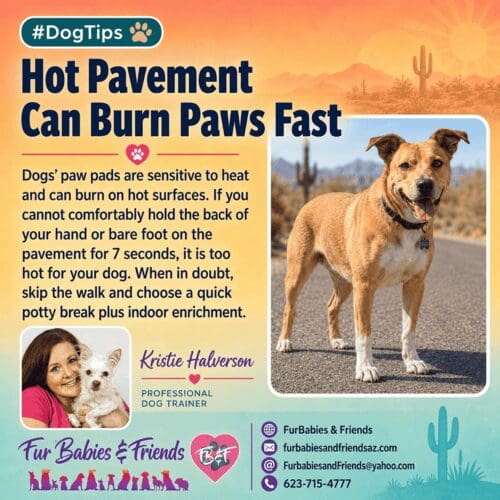
As a general rule, if you cannot comfortably hold the back of your hand or bare foot on the pavement for 7 seconds, it is too hot for your dog to walk on that surface. Maricopa County uses this same pavement test in its pet heat safety guidance and warns that asphalt can become hot enough to cause skin damage quickly.
At FurBabies & Friends, we care for dogs throughout Glendale and the Phoenix West Valley. During Arizona summers, we do not treat every scheduled “walk” as a full outdoor walk. Instead, safety comes first. That may mean a quick potty break, fresh water, indoor enrichment, training games, tug, sniff games, or calm companionship until outdoor conditions are safer.
This guide explains when it is too hot to walk your dog, how to test pavement, what signs of overheating to watch for, when dog booties may help, and how professional dog walkers adjust summer visits to keep pets safe.
Quick Answer: When Is It Too Hot to Walk Your Dog?
| Arizona Condition | Safer Choice |
|---|---|
| Early morning or late evening with cooler pavement | Best time for a longer walk |
| Pavement fails the 7 second hand test | Skip the walk or move to grass or shade |
| Midday triple digit heat | Quick potty break only, then indoor enrichment |
| Dog is panting heavily, slowing down, or seeking shade | Stop activity, move indoors, cool water |
| Puppy, senior dog, flat faced dog, dogs in less than ideal body condition, or high energy dog | Use extra caution and shorten outdoor time |
| No grass, shade, or cool walking surface available | Choose potty only, booties for brief necessary trips, or indoor activity |
| Car ride or quick trip to the vet or groomer | Protect paws during short pavement crossings, but avoid unnecessary outdoor exposure |
The most important thing to remember is this: a safe summer visit does not always mean a full walk. In extreme heat, the safer choice may be a brief potty break followed by indoor activity. Dogs can still receive care, attention, and enrichment without being pushed through dangerous conditions.
Next, let’s look at why Arizona heat is especially risky for dogs.
Why Arizona Heat Makes Dog Walking Riskier
Dogs do not cool themselves the same way people do. Humans sweat across much of the body. Dogs rely mostly on panting, with only limited sweating through their paw pads. Because of this, dogs can overheat faster than many pet parents realize.
Arizona adds another layer of risk. The air temperature may already be extreme, but pavement, asphalt, artificial turf, gravel, and concrete can become even hotter. In direct sun, walking surfaces can hold and radiate heat long after the temperature first climbs.
That matters because dogs are close to the ground. Their paws touch the surface directly, and their bodies absorb reflected heat from the pavement. Therefore, a walk that feels uncomfortable to a person can become dangerous for a dog much faster.
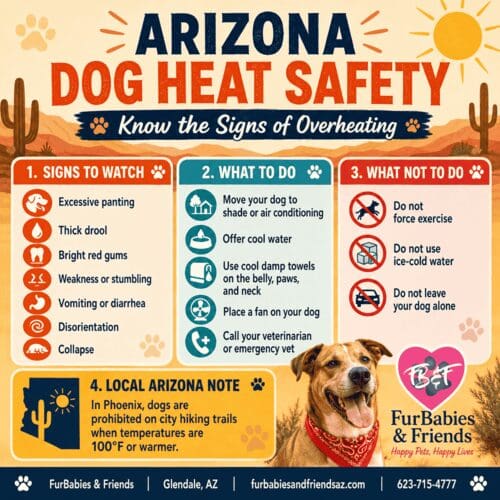
The City of Phoenix also recognizes the danger of extreme heat for dogs. Dogs are prohibited on all City of Phoenix hiking trails when temperatures reach 100 degrees or warmer. That rule is a strong reminder that Arizona heat should not be treated like normal summer weather.
How to Tell If Pavement Is Too Hot for Your Dog
The easiest way to check pavement safety is the 7 second pavement test.
Place the back of your hand or your bare foot on the pavement. If you cannot comfortably hold it there for 7 seconds, it is too hot for your dog to walk on safely.
This test works because your hand or bare foot gives you a better sense of what your dog’s paw pads may feel. If the surface feels painfully hot to you, it is not fair or safe to ask your dog to walk on it.
Hot walking surfaces may include:
- asphalt roads
- sidewalks
- concrete patios
- artificial turf
- gravel
- pool decking
- parking lots
- dark outdoor flooring
In Arizona, pavement can become unsafe even when the air temperature does not seem extreme yet. For that reason, the pavement test matters more than guessing based on the weather app alone.
What Temperature Is Too Hot to Walk a Dog in Arizona?
There is no single perfect temperature that applies to every dog. However, in Arizona, pet parents should become much more cautious as temperatures climb into the upper 80s, 90s, and triple digits.
For many dogs, especially during direct sun or midday heat, the risk increases quickly when pavement becomes hot, shade is limited, or the dog cannot cool down easily.
A short early morning walk may be reasonable on a warm day if the pavement is cool and your dog is comfortable. However, a midday walk at the same temperature may be unsafe because pavement and direct sun exposure are much more intense.
Use these factors before deciding whether to walk:
- Can the pavement pass the 7 second test?
- Is there shade along the route?
- Is your dog already panting before the walk starts?
- Is your dog young, senior, not an a ideal weight, flat faced, double coated, or medically fragile?
- Is the walk necessary, or would a potty break be safer?
- Can you provide indoor enrichment instead?
When in doubt, skip the full walk. A quick potty break and indoor activity are safer than pushing through dangerous heat.
When a Dog Walk Should Become a Quick Potty Break
During Arizona summers, a dog walk should not automatically mean a full walk outside. Sometimes the safest choice is a quick potty break followed by indoor enrichment.
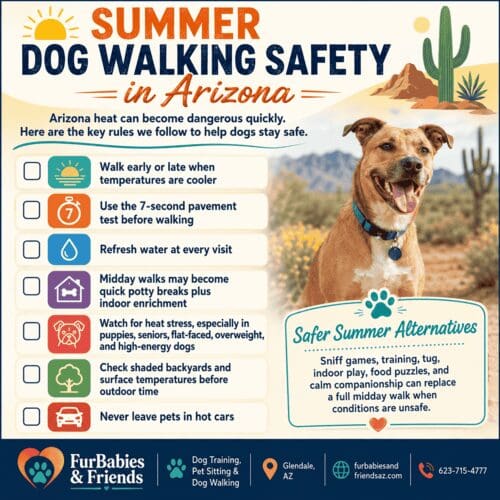
At FurBabies & Friends, we adjust professional pet sitting visits and dog walking visits based on the conditions we see when we arrive. If the pavement is too hot, the dog is already panting heavily, shade is limited, or the temperature is unsafe, we shorten outdoor time and focus on safety first.
A summer “walk” may become:
- a quick potty break at arrival
- a return indoors for water and cool air
- indoor play or training games
- tug, sniff games, or food puzzle enrichment
- calm companionship
- another brief potty opportunity before leaving
This approach still gives dogs attention, movement, and mental stimulation without forcing them through dangerous heat.
Backyards can also be useful, but only when they are truly safe. Shade, surface temperature, supervision, and access to fresh water all matter. Artificial turf, gravel, pool decking, and concrete can become extremely hot, even inside a fenced yard. Therefore, we check the surface before assuming a backyard is safer than a sidewalk.
Safety should always come before routine. A dog will not benefit from a full walk if the heat puts them at risk.
Safe Alternatives to Midday Dog Walks
Dogs still need enrichment during summer. However, enrichment does not always have to come from a long outdoor walk.
When Arizona heat makes walking unsafe, indoor activities can help meet a dog’s mental and physical needs without the same heat risk.
Safe summer alternatives may include:
- sniff games
- treat searches
- basic obedience practice
- short trick training sessions
- tug
- food puzzles
- frozen enrichment toys
- calm brushing or handling practice
- quiet companionship
- brief shaded potty breaks
Sniff games are especially useful because they encourage dogs to use their brain and nose. A few minutes of scent work or treat searching can be more mentally satisfying than a rushed walk on hot pavement.
Training games are another strong option. Practicing cues such as sit, down, touch, wait, place, or leash manners indoors gives dogs structure and attention while keeping them out of dangerous heat.
This matters because dogs need more than physical exercise, which is why our dog walking services focus on safety, enrichment, and individualized care. They also need engagement, routine, and connection. During extreme heat, the goal is not to “skip care.” The goal is to provide care in a safer way.
What Dogs Are Most at Risk in Arizona Heat?
Any dog can overheat in Arizona. However, some dogs need extra caution during hot weather.
Dogs at higher risk may include:
- puppies
- senior dogs
- flat faced breeds
- over or under weight dogs
- double coated dogs
- dogs with heart or breathing conditions
- dogs with dark coats
- high energy dogs that do not self regulate well
- dogs recovering from illness or surgery
Flat faced dogs are especially vulnerable because they often have a harder time breathing efficiently. Since panting is one of the main ways dogs release heat, anything that affects breathing can increase heat risk.
Senior dogs and puppies may also struggle more in extreme temperatures. Senior dogs may have reduced stamina, arthritis, heart concerns, or other medical issues. Puppies may have lots of energy, but they do not always know when to stop.
High energy dogs can also be risky in summer because some will keep playing or pulling even when they are getting too hot. For dogs that struggle to settle, structured dog training and indoor enrichment can help them burn mental energy more safely. These dogs may need more owner guidance, shorter outdoor sessions, and indoor enrichment before they reach the point of overheating.
The safer choice is to plan ahead instead of waiting for a dog to show obvious distress.
Signs Your Dog Is Getting Too Hot
Heat stress can escalate quickly. Because of that, pet parents and dog walkers should watch for early warning signs instead of waiting for a crisis.
Common signs of overheating may include:
- excessive panting
- thick drool
- bright red gums
- weakness or stumbling
- vomiting or diarrhea
- disorientation
- refusing to move
- collapse
If a dog appears overheated, move them out of the heat immediately. Get them into air conditioning or shade, offer cool water, use cool damp towels on the belly, paws, and neck, and contact a veterinarian or emergency veterinarian. Do not force exercise, do not use ice cold water, and do not leave the dog unattended. Maricopa County and Arizona Humane Society both recommend cooling steps that focus on moving the pet to a cooler place, using cool wet cloths, and seeking veterinary help.
This section is not a replacement for veterinary care. If you suspect heat stroke, treat it as an emergency.
Are Dog Booties Safe for Hot Pavement?
Dog booties can help protect paws from hot pavement in limited situations, but they should not be treated as permission to take a full walk in unsafe heat.
Dogs do not cool themselves the same way humans do. They sweat only a small amount through their paw pads and rely mostly on panting to regulate body temperature. Because of this, a dog wearing booties can still overheat quickly in Arizona summer conditions.
At FurBabies & Friends, we view booties as short term paw protection, not a summer walking solution. They may be helpful for a quick trip into the vet, groomer, apartment potty area, or another unavoidable short crossing over hot pavement.
However, if the pavement is too hot for bare paws, the safer choice is usually to skip the walk, move to grass or shade, or switch to a quick potty break plus indoor enrichment.
Booties protect feet. They do not make the heat safe.
What About Hot Cars and Other Pets?
This post focuses mostly on dog walking, but Arizona heat safety applies to all pets. Dogs, cats, reptiles, birds, rabbits, guinea pigs, and other household pets can all be affected by extreme heat, poor ventilation, dehydration, and failing air conditioning.
Cars are especially dangerous. Even a quick errand can become life threatening when a pet is left inside a vehicle. Maricopa County warns that when the outside temperature reaches 100 degrees, the inside of a car can reach 129 degrees in just 20 minutes.
Even short walks across hot parking lots can also burn paws. This matters for trips to the vet, groomer, apartment potty areas, pet-friendly events, or community spaces where dogs may need to cross pavement before reaching shade or grass.
Other pets also need summer safety checks. During pet sitting visits, a professional pet sitter should confirm pets have fresh water, a safe indoor temperature, functioning habitat equipment, and no obvious signs of distress. For reptiles, fish, birds, and small mammals, temperature control and equipment checks can be just as important as food and water.
Arizona heat is not only an outdoor issue. It is also a home safety issue.
How Professional Dog Walkers Adjust During Arizona Summers
A professional dog walker should never follow a routine blindly during extreme heat. Safe summer care requires judgment, communication, and flexibility.
At FurBabies & Friends, our summer dog walking and pet sitting approach includes:
- testing pavement before walks
- shortening outdoor time when needed
- using quick potty breaks instead of full walks during unsafe heat
- choosing shade or grass when available
- monitoring dogs for overheating
- refreshing water bowls at every visit
- checking indoor temperature when clients are away
- communicating concerns quickly
- using indoor enrichment when walking is not safe
This matters because a scheduled visit is not just about exercise. It is about care, safety, and monitoring.
For some dogs, especially dogs who are home while their owners work, a midday visit may still be necessary. However, the purpose may shift from “take a long walk” to “help the dog potty, check their water, give them attention, and keep them safe.”
That is the difference between simply showing up and providing professional pet care.
Need Safe Dog Walking Help in Glendale?
Arizona summers require a different approach to dog walking. Long midday walks may not be safe, but dogs still need potty breaks, fresh water, enrichment, companionship, and someone paying attention to their comfort.
FurBabies & Friends background checked, bonded and insured team provides professional dog walking and pet sitting services throughout Glendale and the Phoenix West Valley. Our team adjusts visits based on the weather, pavement temperature, your dog’s needs, and the safest option available that day.
Whether your dog needs regular weekday visits, vacation pet sitting, or summer potty breaks while you are at work, we help create a care plan that keeps safety first.
Schedule your complimentary pet sitting or dog walking meet and greet today.
Frequently Asked Questions About Walking Dogs in Arizona Heat
There is no single temperature that is safe for every dog. In Arizona, pet parents should use extra caution as temperatures climb into the upper 80s, 90s, and triple digits. Pavement temperature, shade, time of day, and your dog’s age, breed, weight, and health all matter.
If the pavement does not pass the 7 second hand or bare foot test, it is too hot for your dog to walk on that surface.
Use the 7 second pavement test. Place the back of your hand or your bare foot on the pavement. If you cannot comfortably hold it there for 7 seconds, it is too hot for your dog’s paws.
Check asphalt, concrete, artificial turf, gravel, patios, and parking lots. These surfaces can become dangerously hot in Arizona sun.
Yes. Dogs can burn their paw pads on hot pavement, asphalt, concrete, artificial turf, gravel, and other heated surfaces. Paw burns can happen quickly when surfaces are hot enough.
Because of this, it is safer to walk early in the morning or later in the evening when pavement has cooled.
Dog booties can help protect paws during short, necessary trips across hot pavement. However, they should not be treated as permission to take a full walk in unsafe heat.
Dogs rely mostly on panting to cool themselves and only sweat a small amount through their paw pads. Booties may protect feet, but they do not prevent overheating. If pavement is hot enough that your dog needs boots, it is usually too hot for a normal walk.
If midday heat makes walking unsafe, switch to a quick potty break followed by indoor enrichment. Good options include sniff games, treat searches, tug, training games, food puzzles, frozen enrichment toys, or calm companionship.
The goal is not to skip care. The goal is to meet your dog’s needs in a safer way.
Warning signs may include excessive panting, thick drool, bright red gums, weakness, stumbling, vomiting, diarrhea, disorientation, refusing to move, collapse, or seizures.
If you suspect overheating, move your dog into shade or air conditioning immediately, offer cool water, use cool damp towels, and contact your veterinarian or an emergency vet.
Yes, but safe professional dog walkers adjust based on conditions. In Arizona, a summer dog walking visit may include a quick potty break, fresh water, indoor play, training games, enrichment, or companionship instead of a full outdoor walk.
A responsible dog walker should prioritize the dog’s safety over completing a normal walking route.
Yes. Cats, rabbits, guinea pigs, birds, reptiles, fish, and other pets can also be affected by heat, dehydration, poor ventilation, and equipment failures. During summer pet sitting visits, it is important to check water, indoor temperature, habitat equipment, and signs of distress.
About the Author
Kristie Halverson is the owner and trainer at FurBabies & Friends, a force-free, positive reinforcement pet service company based in Glendale, AZ. She provides dog training, pet sitting, dog walking, grooming, and enrichment focused care throughout Glendale and the Phoenix West Valley.
Kristie is a member of the Pet Professional Guild, APDT, IAABC, IACP, and PSI. She is also an approved AKC CGC and STAR Puppy Evaluator. Her work focuses on safe, humane, relationship based care for dogs, cats, and other pets.
Follow FurBabies & Friends on TikTok, Instagram, Facebook, and YouTube at @furbabiesandfriendsaz for training tips, pet care education, and local event updates.